
Mission: Transition programme is organised by Sustainable Together. The events provide a regular opportunity for collaboration and knowledge sharing. The series ties in with the four social challenges of Rotterdam University of Applied Sciences: Sustainable Delta, Future-Proof Economy, Vibrant Community, and Smart & Social City.
Four principles
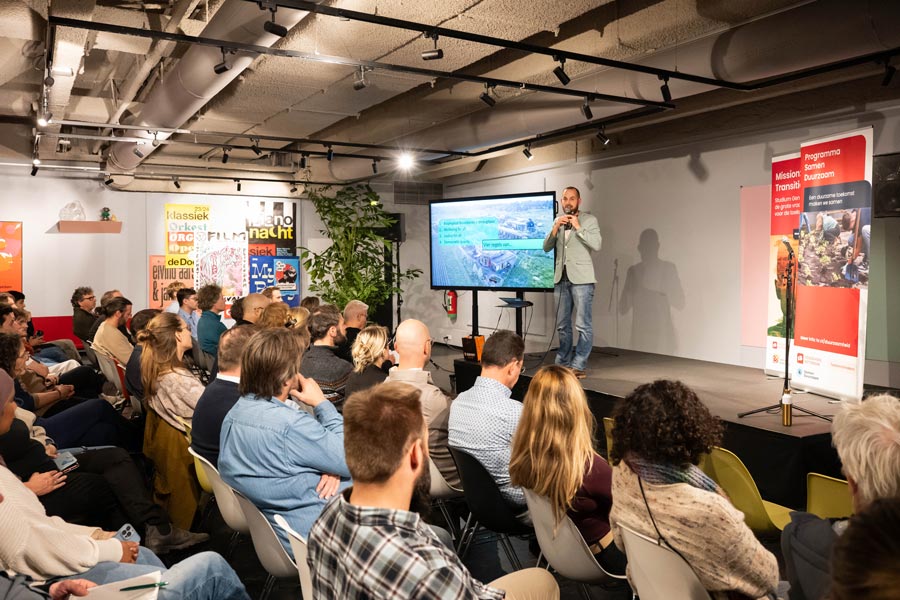
Researcher and lecturer at Rotterdam University of Applied Sciences, University of Amsterdam and Nyenrode Business University, Van Hoften, and researcher and founder of Klimaatplein, Van der Rijt, took to the stage to explain their four principles for healthy, sustainable innovation. They argued that the current innovation model leads to the destruction of nature, inequality, and even the erosion of democracy. “It is time to break away from the ‘innovation dogma’, argued Van Hoften. By this, he means the belief that innovation is inevitable or that more is always better. What is the alternative, according to Van Hoften? Innovation based on degrowth — an approach that prioritises well-being, justice, and ecological balance over endless growth. 'Degrowth' has four key principles:
- Reduce production and consumption, and use regenerative processes.
Currently, our economy uses too many raw materials and energy, which is harmful to the environment. According to this principle, production and consumption must be reduced to a level that remains within the planet's limits. - Strengthen social and economic justice.
Degrowth is not only about producing less; it is also about distributing resources more fairly. Everyone, regardless of where they live or how much they earn, should have equal opportunities. - Support the well-being of life.
The goal is not only human prosperity, but also the protection of animals, plants, and ecosystems. Innovations must contribute to health, happiness, and a liveable planet. - Promote and deepen democratic decision-making.
Decisions about the economy and innovation must be made jointly and transparently. Encourage participation and collaboration so that everyone can contribute ideas about the future.
The researchers suggest a critical reflection on these principles: who benefits from an innovation, and in what way?
Who is ChatGPT for?
Van Hoften demonstrated how the four principles operate in practice. He examined a number of innovations, including ChatGPT. Research shows that students who use AI tend to read and think less well. Link this to the third principle, 'Support the well-being of life', and it is clear that this is not a healthy or sustainable innovation. Van Hoften argues that innovations like this are primarily developed to guarantee economic growth, not to improve life on Earth. Moreover, he explained that innovation is not neutral. Citizens have little influence on innovation cycles and rarely benefit from greater well-being. He concluded with a pointed question: who are we actually innovating for? Are we innovating for ourselves, or to further increase inequality?
Time for action
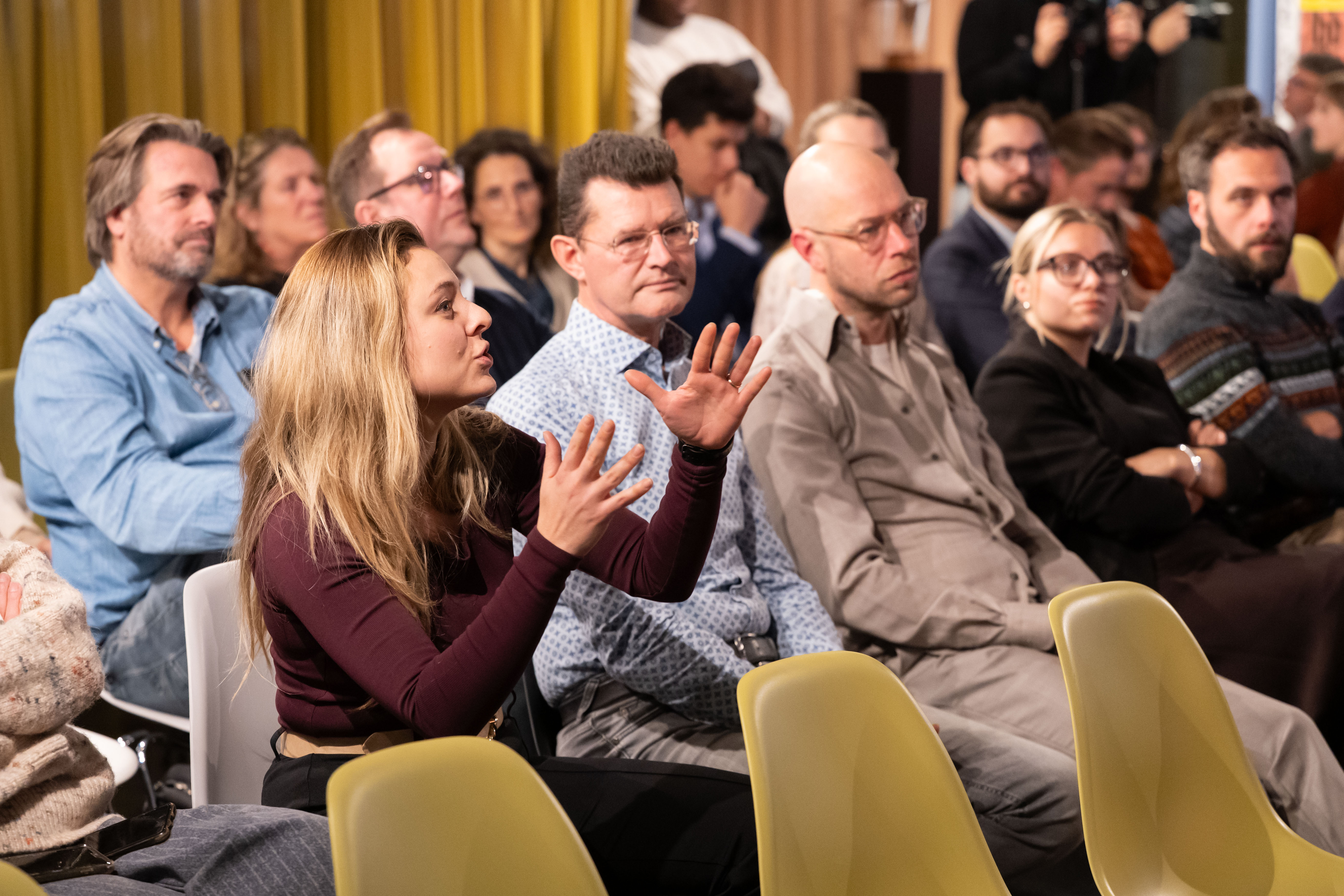
Van der Rijt, a researcher and the founder of Klimaatplein, challenged the audience to apply the principles that his predecessor had discussed. He then divided the audience into groups, each of which was tasked with applying the principles to a company selected by Van der Rijt. The task set was to imagine using 50% less fossil energy and materials next year. What would you do? Lively discussions about possible solutions quickly ensued. “It was useful that we got to put what we had learnt into practice,” said one participant. It gave us the opportunity to put the principles into practice right away,” said one participant.
After-talk at the bar
Even after the interactive session had finished, the audience were still keen to talk. Many participants stayed at the bar in Studio 8 for drinks. There, they shared findings and made new connections. “It's important that an event like Mission: Transition is available,” said one participant. “Here you meet people from other parts of the organisation who are working on the same topic. It provides a platform for knowledge exchange and creating new collaborations.”
Stay informed
Would you like to stay informed about upcoming Mission: Transition events? Join the Samen Duurzaam Teams channel for sustainable events, developments and knowledge sharing.